

















Most AI transformation advice tells you what to do. Almost none of it explains why capable organizations, doing the right things, still fail.
That gap is what Patrick Furu and I set out to understand.
We work closely with leadership teams across industries. The pattern we kept seeing over the past couple of years was consistent: organizations investing seriously in AI, with budgets, mandates, and experience to back it up. Many had navigated digital transformation successfully. By every conventional measure, they were doing the right things.
And yet the results weren't coming.
We started asking a different question. Not "what are these organizations doing wrong?" but "what if they're doing exactly what made them successful, and that's the problem?"
That question is what became Unlearn to Transform.
The finding that surprised us most
The research is unambiguous on the scale of the gap. According to BCG's 2025 study of more than 1,250 firms, only 5 percent of organizations are generating substantial value from AI. 60 percent are getting minimal or no returns despite real investment. The gap between these groups is widening, not closing.
What the major consulting frameworks don't fully account for is why. The diagnosis is usually technology, data, or skills. The evidence points elsewhere.
The organizations in the 5 percent aren't distinguished by superior algorithms or larger budgets. They are distinguished by who they are, their fundamental identity as organizations. And the organizations struggling most are often the ones that have done everything else right. Their past success has built structures, cultures, and instincts that are now actively defending what they were, rather than enabling what they need to become.
This is what we call the Identity-Inertia Complex. It's not a failure of execution. It's a playbook problem. And experience, counterintuitively, can make it worse.
The question behind the paper
Most AI transformation conversations start with "how." How do we implement this? How do we build the capability? How do we manage the change?
We think that's the wrong starting point. "How" assumes the organization asking it already has the trust, the psychological safety, and the identity flexibility to execute the answer. Most don't.
The question that precedes everything else is: who must we become?
It's a harder question. It doesn't have a framework answer. But it's the one that separates the organizations compounding their advantage from those falling further behind with every quarter.
Unlearn to Transform is our attempt to name what's actually happening, and to offer leaders a clearer way to think about what the work really requires.
The full whitepaper is available to download below. We hope it provokes as much thinking for you as writing it did for us.
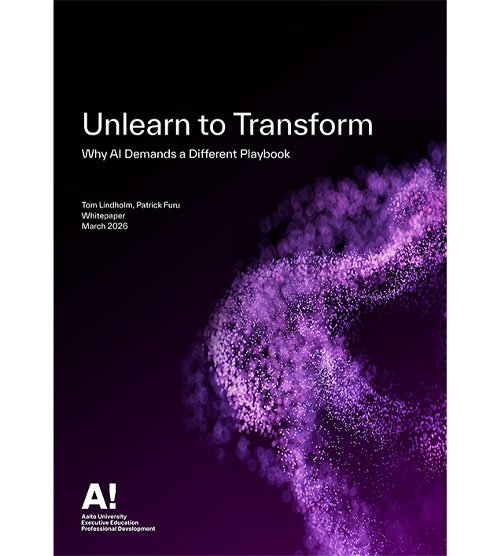 Unlearn to Transform – Why AI Demands a Different Playbook